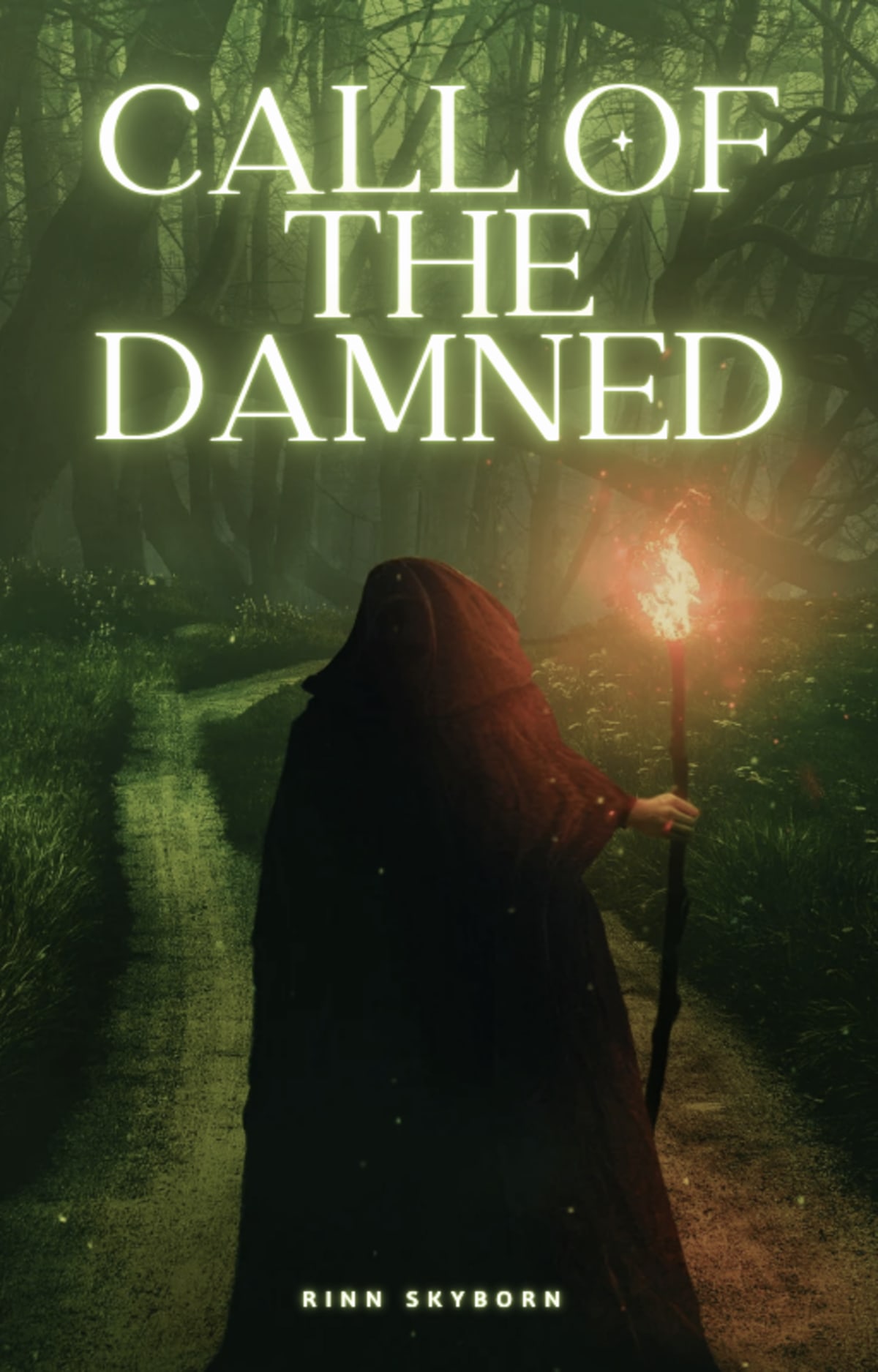
TW: Violence / Abuse
Call of the Damned
Prologue - The Nightmare
I remember the book before I remember the blood. The book was thick and soft with age, its spine cracked like a tired smile. The cover showed a hill split open by moonlight, a woman standing barefoot at its crest, her hair lifting as if the wind itself had chosen her. Gold leaf once traced the letters of the title, but time had worn them dull. I could not read all the words then. I only knew the pictures, and the sound of my mother’s voice moving through them like a tide.
I was small enough that the book felt heavy in my lap. When I held it, it pressed into my thighs, anchoring me to the floor beside the hearth. Ash dusted the stones. The fire popped and sighed, and my mother sat behind me, legs folded to either side of my small body, arms wrapped around me as if I were something precious and fragile that might spill if tipped.
“Again,” I would say, every night, even when I knew the story by heart. And she always did. She always reads again. Her voice was soft but never weak. It held a steady rhythm to it, the kind that made you feel safe enough to close your eyes without fear of what might happen when you opened them again. She smelled of bread and smoke and crushed herbs, and sometimes of rain if she’d been out gathering. Her fingers traced the pictures as she spoke, not because she needed to, but because I liked to watch them move.
“These are old stories,” she would say, as if that mattered, her hands working my long red curls into braids. “Older than this house. Older than the hills. Older than even the words we use to tell them.”
The stories were full of things I wasn’t supposed to talk about outside our walls. Fae who danced in circles of mushrooms. Wisps that lit the marshes and led travelers astray - or home, if they were kind. Queens who were stolen as babies and raised by humans who never knew what they held. Men who struck bargains they could not keep, and women who paid the price for loving them anyway.
When my mother read, the world felt larger. Wider. As if the walls of the house leaned back to listen too. Sometimes she wouldn’t read at all. Sometimes she would close the book and tell the stories instead, the ones passed mouth to mouth, never written down. She said written words could be burned; however, spoken ones had a way of surviving in bones and breath.
“The fae are not evil,” she told me once, brushing my hair with her fingers. “They are not good either. They are old. And old things don’t think the way we do.”
I asked her if the fae were real. She paused, just long enough for me to notice.
“Real enough,” she said. “But not something you should go looking for.”
I nodded solemnly, as children do when they don’t fully understand but trust anyway. Those nights, before my father came home, were the safest I ever knew.
My father did not live with us all the time. He came and went like a storm that hadn’t decided where to break. When he did come, I knew before I saw him. The air changed. The house seemed to hold its breath.
He always smelled of honey mead. Sweet and sour all at once. Thick. Cloying. It wrapped around him like a second skin, seeping into the wood of the doorframe, into the rugs, into my clothes when he lifted me without asking. Even now, the smell can make my stomach tighten, can pull me backward through the years like a hook in the ribs.
At first, when I was very small, I liked him. He was loud and big and laughed too hard. He lifted me onto his shoulders and called me his little sprite, his forest girl. He brought carved toys and ribbons dyed in strange colors. When he was sober, he told stories too - different ones. Stories of hunts and feasts and how strong he was, how feared, how respected. He never told me how respect is a fragile thing when soaked in drink.
My mother always knew how to move around him. She spoke softly when he was loud, lowered her eyes when his gaze sharpened. She touched his arm before he could slam his hand down, murmured words meant only for him. She guided him away from me without ever saying my name, as if naming me might remind him I was there. I knew without words when to stay small, when to hide in the herb cabinet, or to stay quiet in the corner.
If his voice rose, she would sing. If his steps staggered toward me, she would step between. If his anger sparked, she smothered it with her body, with her voice, with whatever it took.
I didn’t understand this then. I only knew that when he came, my mother’s hands never stopped moving. Kneading dough. Folding cloth. Stroking my hair. Always busy, always ready.
She told me to go to my room more often than not when he was there. To read. To play quietly.
“Stories are doors,” she whispered once, pressing the book into my hands. “If you need to leave, you open one.”
I took that seriously. The night everything broke, the book was already open.
I remember that clearly. The picture of a hill ringed with stones, a girl standing at its center, her shadow wrong somehow - too long, too sharp. I had traced that shadow with my finger so many times that the page was thin there. Sometimes I felt wrong, like I didn’t quite fit.
The door slammed hard enough to rattle the cups, making my heart sink in my chest. My father came home earlier than expected. I flinched, even from room, the honey mead smell came fast, rolling through the house like a fog. Voices followed. His, loud and uneven. My mother’s calm but strained, like a rope pulled too tight.
I slid off my bed and tucked myself beneath it without thinking. It was something I’d done before, during storms, during shouting in the village. Under the bed was dark and dusty but it was safe. I pulled the book with me, pressing it to my chest.
The floorboards creaked as he paced.
“You think I don’t know?” he slurred. “You think I don’t see it?”
“I don’t know what you mean,” my mother started, her voice soft. There was a sound then - wood against wood. The table, I think. Something heavy.
“Liar.” His voice was thunderous, hard.
I pressed my face into the book, breathing in its old - paper smell, trying to make myself small enough to disappear into the stories. My heart beat too fast, too hard. I counted breaths as my mother had taught me. In. Out. In. Out.
His voice rose, words tumbling over each other.
“Milk spoils when you leave it out,” he hissed. “Women spoil when they get ideas. When they think they’re smarter than men.”
I heard my mother say my name. Just once. Softly.
“Sabi…” That was when fear wrapped its hands around my throat. Then came the first sound that broke something inside me. A slap.
It was sharp. Loud. Not like the dull thuds I’d heard before when he struck walls or doors. This was skin on skin. A sound that carried weight. I bit my lip so hard I tasted blood.
“Don’t,” my mother gasped.
Another sound. A grunt. Something falling.
“You think I don’t smell it on you?” he shouted. “The woods. The night. You think I don’t see how they look at you?”
“I don’t know what you’re talking about,” she pleaded again, but her voice was different now. Higher. Hurt.
“The fae,” he spat, as if the word itself burned his tongue. “You’ve made a deal. I know it. I see it in the child.”
My breath caught. In the child.
My fingers dug into the book’s pages, crumpling the picture of the hill.
“She’s wrong,” he went on. “She watches too much. Knows too much. No child should know the things she knows.”
I wanted to scream that I only knew stories. Those stories weren’t real. That my mother said so. But another part of me a small, quiet, listening part, remembered her pause when I’d asked if the fae were real.
There was another slap. Harder this time. I heard my mother cry out. I pressed my fist to my mouth, muffling a sound I didn’t know I was making.
“Witch,” the word was thick with drink, twisted by rage. “You think I won’t burn you for it? You think I won’t drag you to them myself?”
My body shook so hard the bedframe rattled. I froze, terrified the sound would give me away. Under the bed, the world was a narrow strip of shadows. I could see my mother’s feet. Bare. One foot slid back, then stilled.
Then I heard something wet and terrible. The sound of a fist hitting flesh. Again. And again. Each hit landed somewhere inside me, echoing through my chest.
“Stop,” my mother whispered.
There was a moment, just a moment - where the house went quiet, as if even the walls had held their breath.
Then his voice dropped low. “You gave her to them, didn’t you? You traded our daughter for that thing.”
Silence.
“You gave her to them,” he said again, louder now. “And they gave you something in return.”
I thought of the stories. Of bargains and prices. Of queens stolen and children left behind. I thought of my mother’s hands glowing faintly green when she crushed herbs in the mortar, something I’d once thought was a trick of the firelight. I thought of how the woods always seemed to open for her.
Another blow.
This one made a different sound. A dull crack. My mother cried out, sharp and broken. I screamed then. I couldn’t help it. The sound tore out of me, thin and animal.
“Sabi!” my mother called, her voice was desperate now. Afraid. Footsteps turned. Heavy. Staggering. The bedframe creaked. A face appeared in the dark, upside down and red and terrible. My father’s eyes were wild, glassy with drink and something worse. The honey mead smell flooded my lungs.
“There you are,” he said softly. Too softly.
I curled around the book, trying to make myself disappear.
“She’s hiding,” he said, as if this were proof of something insidious. “Just like you taught her.”
“No,” my mother said. She was closer now. I could see her legs trembling. “Leave her alone.”
“She’s theirs,” he snarled. “I won’t let them have her.”
His hand reached for me.
My mother moved.
I didn’t see what she did. I only heard the sound of breath leaving a body fast, and my father shouting in surprise. The bedframe jolted as something hit it hard.
“Sabi, don’t look,” my mother said. She stood between us, her hair loose, her face streaked with blood. Her eyes were not afraid. They were furious.
For a heartbeat - just one - I thought I saw something else there. Something old. Something bright.
My father laughed, hoarse and unsteady.
“See?” he crooned. “There it is.”
Then everything happened too fast.
I remember being pulled, the book slipping from my hands. I remember my mother screaming my name like it was a spell. I remember the sound of wood breaking, of glass shattering.
I remember light. Green and pale and wrong.
And then - Nothing.
When I woke, the house was quiet. Too quiet.
The bed was above me again. The book was clutched to my chest. My fingers hurt from holding it so tightly. I crawled out slowly, my limbs stiff and aching.
My father was gone. The room smelled of smoke.
The door hung open, broken on its hinges. Cold air rushed in from the woods beyond. On the floor, near the door, was a single footprint that glowed faintly green before fading away.
I picked up the book and held it close.
I knew then that stories were not just doors.
They were warnings.
And some of them were about me.
I don’t remember hearing the door open.
I only remember the smell of the sea forcing its way into the house, cutting through smoke and iron and spilled mead. Salt and cold storms that had never learned how to be gentle.
I was on the floor when she came in. Curled in on myself beside the bed, my knees pulled to my chest so tightly they hurt. My storybook lay open on the floor beside me, its spine cracked and worn, pages trembling under my hand as I read without seeing.
“…and the child was hidden beneath the hill,” I whispered, my voice barely there. “And the fire could not find her.”
Tears soaked my cheeks, blurring the page. The crowned woman in the illustration is melting into the shadows.
Something wet caressed my shoulder, like rain.
“Sabi,” a voice broke through. Not loud. Never loud. It rolled like tidewater over stones.
I looked up.
Rose stood in the doorway, framed by broken wood and moonlight. Her dark hair hung loose and damp, curling as if it had never truly dried. Her skirts dripped seawater onto the floor, each drop striking the boards like a slow, measured heartbeat.
Her eyes took in the room in a single breath. The overturned table. The shattered glass. The blood smeared across the stones as a story told too violently.
And my mother.
She lay sprawled near the hearth, her body twisted wrong, hair matted dark against her face. Blood pooled beneath her head, already cooling, already dull. Her eyes stared sightlessly at the ceiling, one swollen shut, the other glassy and empty. She was not breathing.
Rose made a sound then. Not a scream. A low, broken sound, like a wave shattering against a cliff that would not move.
“Oh,” she whispered.
Melody moved from behind Rose, kneeling beside the broken form of my mother, clutching her hand with both of hers. She was shaking so badly her teeth clicked together.
“She won’t wake up,” Melody sobbed. “Momma, she won’t wake up.”
Rose crossed the room in three strides. She knelt, pressing her fingers to my mother’s throat, then her wrist. Her hand lingered there longer than it needed to.
Nothing.
Her face folded inward, grief carving something ancient and feral into her expression.
“She’s gone.” The words landed like a stone dropped into deep water.
Melody let out a wail that ripped through the room. She collapsed forward, pressing her face into my mother’s bloody palm.
“No,” she cried. “No, no, no…. We came as fast we we could… we- ”
I couldn’t move. I stared at my mother’s face, waiting for it to soften, to breathe, to become my mother again.
It didn’t. Something inside me cracked open.
Rose turned then. Her gaze found me instantly, like a current snapping tight. There I was a small, shaking, streaked with dust and tears, clutching a book of myths like a shield that had failed to save anyone.
Her eyes filled.
“Oh, little tide,” she whispered.
She came to me and knelt, and for a moment she didn’t touch me at all. She only looked - really looked, at the bruises blooming on my arms, the way my fingers trembled around the book, the hollow shock already settling into my face.
Something hardened behind her grief.
She reached for me, and this time when she touched me, it was with certainty. She scooped me up against her chest, one arm unyielding around my back, the other hand sliding beneath my knees. I dropped the book in my shock, and she snatched it up without looking, tucking it against me as if she knew it mattered.
I buried my face into her shoulder and cried. I cried until my throat burned and my chest ached and my tears soaked into her damp wool. She rocked me, slow and relentless, like the sea pulling a child back from drowning.
“I’ve got you,” she murmured over and over. “I’ve got you. You’re safe. You’re safe now.”
Behind us, Melody cried my name.
“Sabi,” she sobbed. “Sabi, I’m so sorry Sabi….”
Rose tightened her hold on me.
“She cannot stay,” Rose said, her voice steel. “Not here. Not after this.”
“She’s her mother,” Melody cried. “She can’t leave her-”
Rose turned, fury flashing bright as moonlight on waves.
“She is her mother,” Rose said. “Which is why I will not let her die here, too.”
She looked down at me again, softer now, devastatingly so.
“I will take her,” Rose said, as if speaking a vow to the bones of the house. “By tide and law and blood if I must. She is mine now.”
Mine.
The word wrapped around me like a promise I didn’t yet understand. Rose pressed her cheek to my hair, her breath shuddering.
“I know,” she said. “I know, little one.”
She carried me toward the door. As she crossed the threshold, I looked back one last time. My mother lay still on the stones, blood dark and drying beneath her. The fire crackled beside her, uncaring. The house felt empty already.
The woods beyond the door loomed dark and waiting.She stepped into the night, sea - salt wind rising to meet us, and held me as if she would never let go. Somewhere deep beneath my terror and grief, something old and instinctive recognized the truth….
The tide had claimed me.